
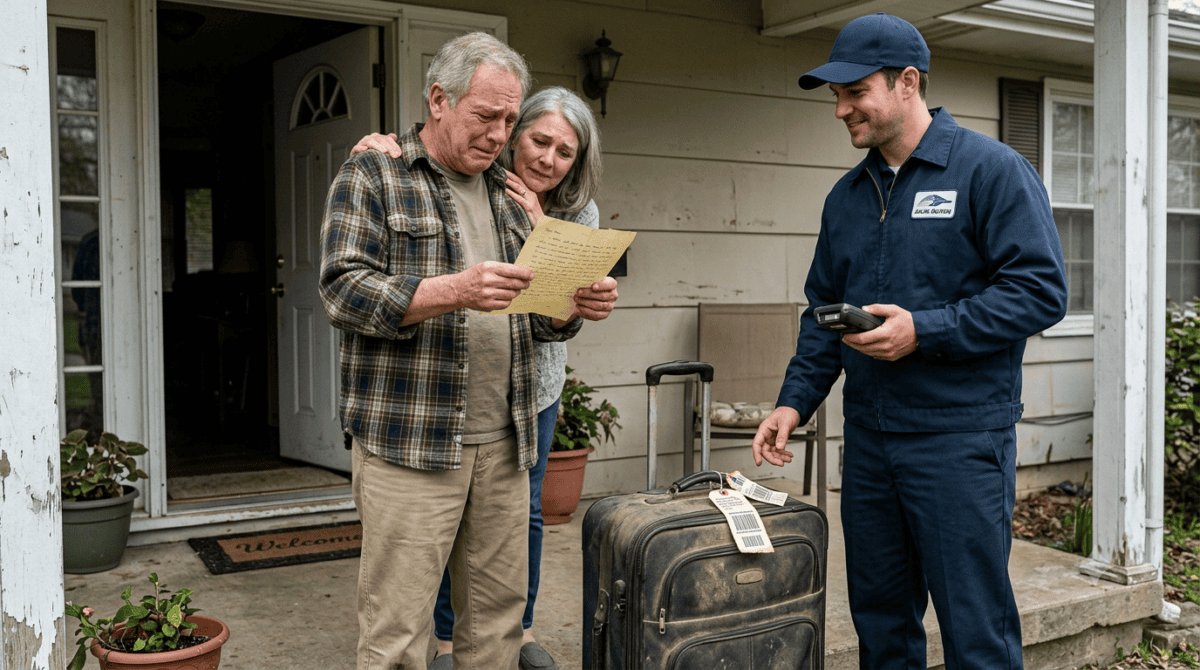
The rain in Seattle had a particular rhythm in November, a steady, persistent tapping against the living room window that Arthur Vance had grown accustomed to over the last two decades. At sixty-four years old, Arthur was a man who appreciated predictability. His days were measured by the quiet hiss of his morning espresso machine, the methodical organization of his architectural drafting table, and the evening walks he took with his aging golden retriever, Barnaby. There were no surprises in Arthur’s life, and for the better part of nineteen years, he had preferred it that way.
That quiet predictability ended on a Tuesday afternoon with three sharp knocks at his front door.
Arthur set down his mechanical pencil, adjusted his reading glasses, and walked down the hallway. Barnaby followed lazily behind, letting out a low, half-hearted woof. When Arthur pulled open the heavy oak door, he expected to see a delivery driver dropping off a package of drafting paper or perhaps a neighbor returning a borrowed hedge trimmer. Instead, standing on his porch in a damp navy blue uniform was a young man holding a clipboard and standing beside a large, scuffed, dark green canvas suitcase.
Arthur stared at the bag. A strange, cold sensation washed over him, the kind of disorientation you feel when you see someone you thought had passed away walking down a crowded street. The suitcase had a faded yellow luggage tag dangling from the top handle, held together by a frayed piece of clear packing tape. A small tear near the bottom right zipper had been patched with a square of black duct tape.
Are you Arthur Vance? the courier asked, squinting at the clipboard against the misty drizzle.
Yes, Arthur said, his voice sounding distant even to his own ears. That is me.
I have a delayed baggage delivery from Meridian Airlines, the young man said, shifting his weight from one foot to the other. The system flagged this as an unresolved claim from… well, the date on the manifest says October 2007. Honestly, sir, I thought it was a typo when the warehouse supervisor handed me the route sheet this morning. Apparently, they were renovating the sub-basement storage facility at the Denver hub, tore down a false wall behind an old conveyor belt system, and found a whole pocket of lost bags that had fallen off the tracks years ago. Yours was wedged right at the bottom.
Arthur did not reach for the pen the courier was offering. He could not take his eyes off the black duct tape. He had put that tape there himself in a motel room in Chicago in the autumn of 2007. He remembered the exact smell of that cheap motel room, the stale coffee, the humming fluorescent light in the bathroom, and the heavy, suffocating weight in his chest as he packed his things in a hurry.
Sir? the courier prompted gently. I just need a signature on the release form so I can close out the ticket.
Arthur blinked, pulling himself back to the present. He took the pen, his fingers slightly stiff, and signed his name on the digital pad. The courier thanked him, wished him a good afternoon, and walked back down the stone pathway toward his delivery van.
Arthur stood on the porch for a long time after the van had pulled away, the cool mist settling on his shoulders. Finally, he bent down, grabbed the retractable handle of the green canvas suitcase, and pulled it inside. The wheels squeaked, a high-pitched, rusty sound that echoed through the quiet foyer. He rolled it into the living room, stopping right in front of the worn leather armchair near the fireplace.
Barnaby walked over, sniffed the canvas thoroughly, sneezed once, and then curled up on the rug beside it.
Arthur sat down in the armchair and stared at the bag. October 2007. Nineteen years ago.
To understand what was inside that suitcase, Arthur had to force himself to remember who he had been in October 2007. Back then, he was forty-five years old, driven, ambitious, and relentlessly stubborn. He was a partner at a mid-sized architectural firm in Seattle, working seventy hours a week to prove he deserved his name on the letterhead. He believed that success required absolute rigidity, that standards were meant to be enforced, and that people who failed to meet expectations simply lacked discipline.
That rigidity had been the wedge that split his family in two.
His younger brother, Julian, was everything Arthur was not. Julian was a musician, a dreamer who drifted from city to city, playing acoustic guitar in small coffeehouses and scraping by on freelance audio engineering gigs. While Arthur built concrete and steel structures meant to last a century, Julian built fleeting melodies that evaporated the moment the last chord faded.
For years, Arthur had tolerated Julian’s lifestyle with a mixture of quiet condescension and reluctant financial bailouts. Whenever Julian’s car broke down or his rent was overdue, Arthur would wire the money, always accompanied by a stern lecture about responsibility, planning for the future, and growing up. Julian would thank him, promise to do better, and then six months later, the cycle would repeat.
The breaking point came in the autumn of 2007. Their mother had passed away the previous spring, leaving behind a modest estate and a small house in coastal Oregon. As the executor of the will, Arthur had meticulously cataloged every asset, every debt, and every piece of furniture. He wanted to sell the house quickly, split the proceeds evenly, and close the chapter cleanly.
Julian, however, was struggling with the grief in a way Arthur could not comprehend. Julian wanted to keep the house, even though neither of them could afford the upkeep on their own without dipping into savings Arthur was unwilling to touch. Worse, Julian had stopped returning Arthur’s calls, leaving legal paperwork unsigned for months, stalling the probate process and costing the estate thousands of dollars in unnecessary taxes and fees.
In October 2007, Arthur had flown to Chicago for a three-day architectural conference, with a connecting flight through Denver on the way back to Seattle. Julian was living in Chicago at the time, crashing in a cramped studio apartment in Wicker Park. Arthur had decided that if Julian would not answer his phone, they would settle the matter face to face.
They met at a diner near Julian’s apartment on a cold, windy Tuesday night. What was supposed to be a thirty-minute conversation over coffee turned into a two-hour shouting match that drew stares from the other patrons and eventually got them asked to leave by the manager.
Arthur had brought a thick folder of legal documents, spreading them across the sticky laminate table, pointing out numbers, dates, and missed deadlines. He told Julian that he was tired of carrying him, tired of cleaning up his messes, and tired of watching him waste his life chasing a pipe dream that was never going to pay the bills. He told Julian that their mother had spent her final years worrying about him, and that Julian’s selfishness was an insult to her memory.
Julian had sat there, pale and quiet at first, his hands wrapped around a mug of lukewarm coffee. When he finally spoke, his voice was shaking with a mixture of grief and fury. He told Arthur that Arthur did not know anything about their mother’s final years because Arthur was always too busy working to visit her. Julian had been the one driving down to Oregon every other weekend to take her to doctor appointments, to fix her leaky roof, and to sit with her when the loneliness became too much. Julian had fallen behind on his own life because he was trying to hold hers together while Arthur sent checks from a distance and called it love.
Arthur had not listened. Blinded by pride and anger, he had called Julian a liar and a parasite, picked up his folder, and walked out into the freezing Chicago wind.
The next morning, Arthur had packed his green canvas suitcase in his motel room, ripped the zipper slightly in his haste, patched it with duct tape, and headed to O'Hare Airport. He boarded his flight to Denver, his jaw clenched so tight his teeth ached. When he landed in Denver, his connecting flight to Seattle was delayed by four hours due to an early winter storm rolling over the Rockies. When he finally arrived in Seattle late that night, exhausted and bitter, he stood at the baggage carousel for an hour watching the belt spin empty.
Meridian Airlines apologized, handed him a claim form, and promised the bag would turn up within forty-eight hours. It never did. After ninety days, the airline sent him a standard reimbursement check for five hundred dollars, and Arthur wrote the whole thing off.
In a strange way, losing the suitcase had felt symbolic to Arthur at the time. He told himself he was shedding dead weight. He stopped calling Julian. Julian stopped calling him. When the estate finally settled six months later through attorneys, Arthur had Julian’s share wired directly to his bank account without a single word attached.
Nineteen years had passed since that night in the Chicago diner. Nineteen years of silence. Arthur had divorced a few years after the fallout, his marriage crumbling under the same relentless work ethic and emotional distance that had driven his brother away. He had retired early at sixty, realizing too late that the corner office and the accolades felt hollow when there was no one left to share them with. He had thought about Julian often over the years, especially around the holidays or on Julian’s birthday in May. Several times, Arthur had even typed Julian’s name into an internet search bar, finding traces of him—a listing for a small recording studio in Nashville, a credit on an independent folk album from 2015, a blurry photo from a local music festival in Austin. Each time, Arthur’s hand had hovered over the phone, and each time, pride and fear had stopped him. What do you say after nineteen years? How do you bridge a chasm that wide when you were the one who dug it?
Now, sitting in his living room in Seattle, Arthur reached down and unzipped the main compartment of the green canvas suitcase.
The zipper resisted at first, stiff with age and dust, before giving way with a sharp metallic rasp. A faint, nostalgic scent wafted up from the fabric—a mix of stale airplane cabin air, cedarwood cologne he used to wear in his forties, and old paper.
Inside, everything was exactly as he had left it. His neatly folded dress shirts, a pair of dark wool slacks, a leather toiletry bag, and a hardcover book on modernist architecture he had been reading on the plane.
Arthur reached into the side pocket, his fingers brushing against a bundle of folded papers. He pulled them out. There were his boarding passes from October 2007, a receipt from the Chicago motel, and beneath those, a thick, cream-colored envelope.
Arthur frowned. He did not recognize the envelope. It was sealed, slightly yellowed around the edges, and had a faint smudge of grease near the bottom corner, as if it had been slid under a door or tucked hurriedly into a pocket.
Written across the front, in familiar, looping blue ink, was a single word: Arthur.
Arthur’s breath caught in his throat. He knew that handwriting. He had seen it on birthday cards, scribbled on the backs of setlists, and signed at the bottom of frantic notes asking for a little help to get through the month. It was Julian’s handwriting.
His hands trembling slightly, Arthur slid his thumb under the flap of the envelope. The glue had dried out over the decades, giving way easily without tearing the paper. Inside were two sheets of lined notebook paper, folded neatly into thirds.
Arthur unfolded the pages, adjusted his glasses, and began to read.
*Wednesday morning, 6:30 AM.*
*Artie,*
*I am writing this sitting in the hallway outside your motel room. The guy at the front desk was nice enough to tell me which room you were in when I described your car, though he made me promise I would


