
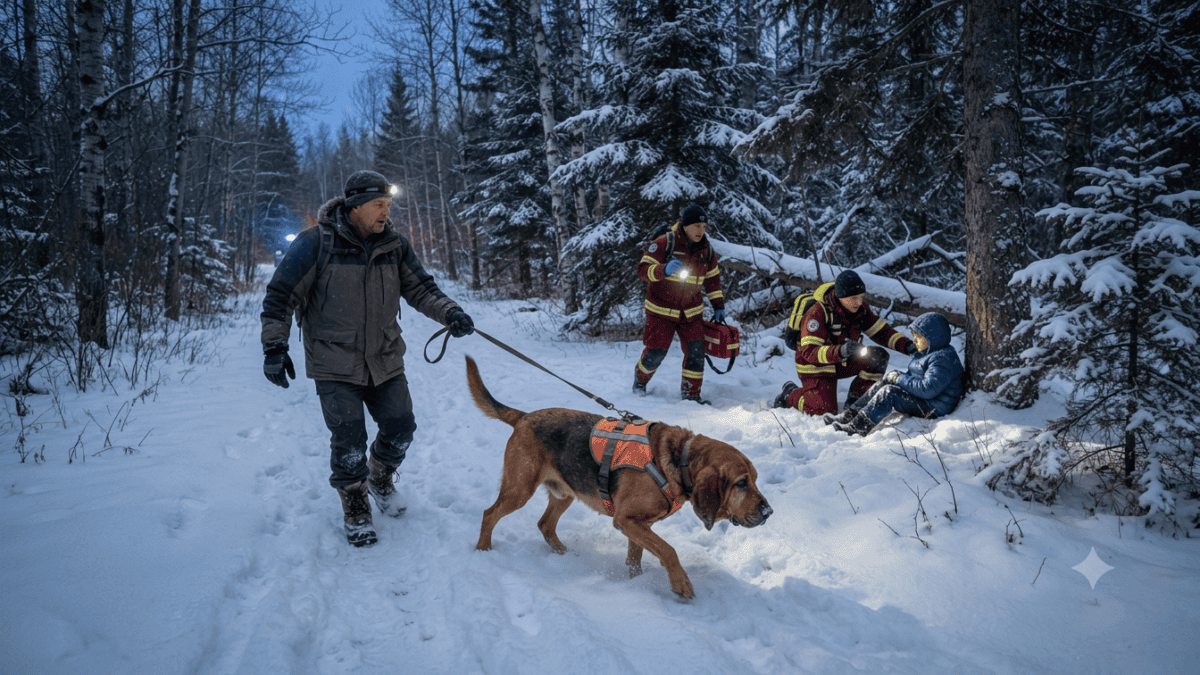
The winter wind had already begun to bite through Arthur’s heavy wool coat by the time the sun dipped behind the jagged ridge of the Cascade foothills. At sixty-eight, Arthur knew the rhythm of these woods better than the lines on the back of his own hands. Every evening, just before twilight settled into the deep purple dark of a Pacific Northwest winter, he clipped a worn leather leash to the collar of his companion, Barnaby.
Barnaby was thirteen years old, a massive, loose-skinned bloodhound whose coat had long since faded from rich mahogany to a dusty, silvered tan around his muzzle and ears. For nearly a decade, Barnaby had been one of the finest search-and-rescue dogs in the county. He had tracked lost hikers through dense fog, found wandering elders in thickets of blackberry brambles, and pulled frightened children out of the deep timber before the night cold could claim them.
Now, though, Barnaby moved at a slow, deliberate shuffle. A thick, milky haze covered both of his eyes, the result of advanced cataracts that had stolen almost all of his sight over the past two years. His hips ached when the barometric pressure dropped, and his once-booming bay had softened into a low, raspy grumble. Retirement had been hard on the old dog at first, as it often is for working animals whose entire sense of purpose is bound to a harness and a trail. Arthur made sure they still walked the perimeter of their property every single evening, sticking strictly to the flat, packed-snow logging road that ran parallel to Cedar Creek. It was safe, predictable, and easy on Barnaby’s joints.
That Tuesday evening in late January, the temperature was dropping fast. A heavy snowstorm had swept through the valley the night before, leaving nearly a foot of fresh powder blanketing the forest floor, though the logging road itself had been cleared by a neighbor’s plow earlier that morning. The air smelled sharp and clean, carrying the crisp scent of crushed pine needles and woodsmoke drifting from the chimneys down in the valley.
Arthur and Barnaby had covered about half a mile when the old dog suddenly stopped dead in his tracks.
At first, Arthur thought Barnaby’s arthritis was flaring up. He stopped beside the hound, resting a gloved hand on the broad, warm skull between those long, velvety ears. Take your time, old man, Arthur murmured softly, his breath puffing white in the freezing air. We can turn back whenever you are ready.
Barnaby did not turn back. Instead, the heavy head lifted. The long, wrinkled ears twitched forward, and the broad black nose began to work furiously, drawing in deep, rhythmic gulps of the frigid evening air. Despite the milky blindness in his eyes, Barnaby’s posture changed entirely. The sag in his shoulders vanished. His spine straightened, his tail rose like a flagpole, and a low, vibrating whine rose from deep within his chest.
Before Arthur could fully register the shift, Barnaby lunged forward.
For a thirteen-year-old dog with bad hips, the sudden burst of strength was startling. The leather leash snapped taut in Arthur’s grip, nearly pulling the older man off balance on the slick edge of the road. Barnaby stepped right off the plowed path and plunged chest-deep into the untouched snowbank leading into the dense timber.
Barnaby, no, Arthur called out, tugging gently on the lead. That is off the trail, buddy. Come on, you cannot see where you are going.
Barnaby ignored him completely. In all his years as a handler, Arthur knew that look and that pull. It was not the wandering curiosity of an old pet chasing a rabbit scent. It was the unmistakable, locked-in drive of a working bloodhound who had just caught a human air scent on the wind. Decades of training and thousands of years of breeding had just overridden every ache in Barnaby’s aging body.
A cold knot tightened in Arthur’s stomach. Nobody lived up on this stretch of the ridge except Arthur and his nearest neighbor, a retired schoolteacher who was currently spending the winter in Arizona. No hikers came up the logging road after dark in January. If Barnaby had caught a human scent drifting down from the timberline, someone was out there in the freezing dark who had no business being there.
Arthur did not fight the leash anymore. He tightened his grip, flipped on the high-beam LED flashlight clipped to his coat, and let the blind hound take the lead.
Barnaby plowed through the snow like a furry icebreaker. He could not see the fallen logs, the tangled roots, or the low-hanging cedar branches heavy with snow, so he used his massive shoulders and broad chest to push straight through them. Every few yards, he would pause for a fraction of a second, dip his nose into the snow to check the ground scent, and then lift his head to sample the shifting breeze before surging forward again.
Arthur struggled to keep pace, his boots sinking deep into the powder with every step. The cold was brutal now that the sun was completely gone. His phone had barely two bars of signal out here, and he knew that if someone was stranded in these woods without proper winter gear, they had very little time before hypothermia began shutting down their organs.
Keep going, Barnaby, Arthur breathed, his heart hammering against his ribs as he swept his flashlight beam across the dark trunks of the Douglas firs. Show me where they are.
For twenty minutes, the blind dog dragged his handler deeper into the ravine toward the icy rush of Cedar Creek. The terrain grew steeper and more treacherous. Arthur slipped twice, catching himself against rough bark, while Barnaby never faltered once. The old dog’s nose was guiding him with pinpoint precision through a world he could no longer see.
Then, near the base of a massive hollowed-out cedar tree just twenty feet above the freezing creek bank, Barnaby let out a single, resonant bay that echoed off the canyon walls.
Arthur swung his flashlight beam toward the base of the tree. Half-buried in a drift of snow, curled tightly into a ball to preserve whatever tiny bit of warmth remained in his body, was a small boy.
Arthur rushed forward, dropping to his knees in the snow beside the child. The boy looked to be about eight years old. He was wearing a thin zip-up hoodie, jeans soaked through to the thighs, and sneakers with no socks. His lips were a pale, frightening shade of blue, and he was shivering so violently that his teeth clicked together audibly. His eyes were half-closed, unfocused and glassy—the classic, terrifying signs of moderate to severe hypothermia.
Hey there, buddy, I have got you, Arthur said quickly, shrugging off his heavy wool coat and wrapping it tightly around the boy’s trembling frame. Barnaby immediately pressed his massive, warm body right up against the child’s side, draping his heavy chin over the boy’s shoulder and letting out soft, reassuring whines.
With trembling fingers, Arthur pulled out his cell phone and dialed 911. Somehow, down in the bottom of the ravine, a single bar of service held steady.
When the dispatcher answered, Arthur gave his exact coordinates and described the boy’s condition. Within minutes, the distant wail of sirens began echoing up the valley road. Because Arthur knew the logging trails intimately, he was able to guide the county search-and-rescue team and paramedics directly down into the ravine using his flashlight beam as a beacon.
As the paramedics lifted the boy onto a thermal rescue sled and began warming him with heated blankets, a sheriff’s deputy approached Arthur, shaking his head in disbelief.
You have no idea how lucky this kid is, the deputy said, shining his light briefly toward Barnaby, who was still sitting faithfully beside the stretcher, refusing to leave the boy’s side until the doors of the rescue vehicle closed. His parents called him in missing less than an hour ago from the campground two miles south of here. He wandered off looking for his lost glove and got completely turned around when the snow started blowing. With the temperature dropping below twenty degrees tonight, if you had found him even thirty minutes later, we might have been looking at a tragedy.
Arthur looked down at his old dog. Snow clung to Barnaby’s silvered whiskers, and his milky eyes stared blankly into the dark woods. Yet his tail gave a slow, proud thump against the packed snow.
Later that evening, after the boy had been safely transported to the regional hospital where doctors confirmed he would make a full recovery, Arthur walked Barnaby back up the logging road toward their warm cabin. Barnaby moved slowly again, the adrenaline fading from his aging muscles, leaning slightly against Arthur’s leg with every step.
When they got inside, Arthur dried the old hound off with thick towels, served him a double portion of warm beef broth over his dinner, and settled beside him in front of the woodstove. Barnaby let out a long, contented sigh, resting his heavy head across Arthur’s boots. His eyes may have lost their light years ago, and his days on the active roster were long behind him, but when a life hung in the balance in the freezing dark, the heart of a rescuer knew exactly how to find the way.


