
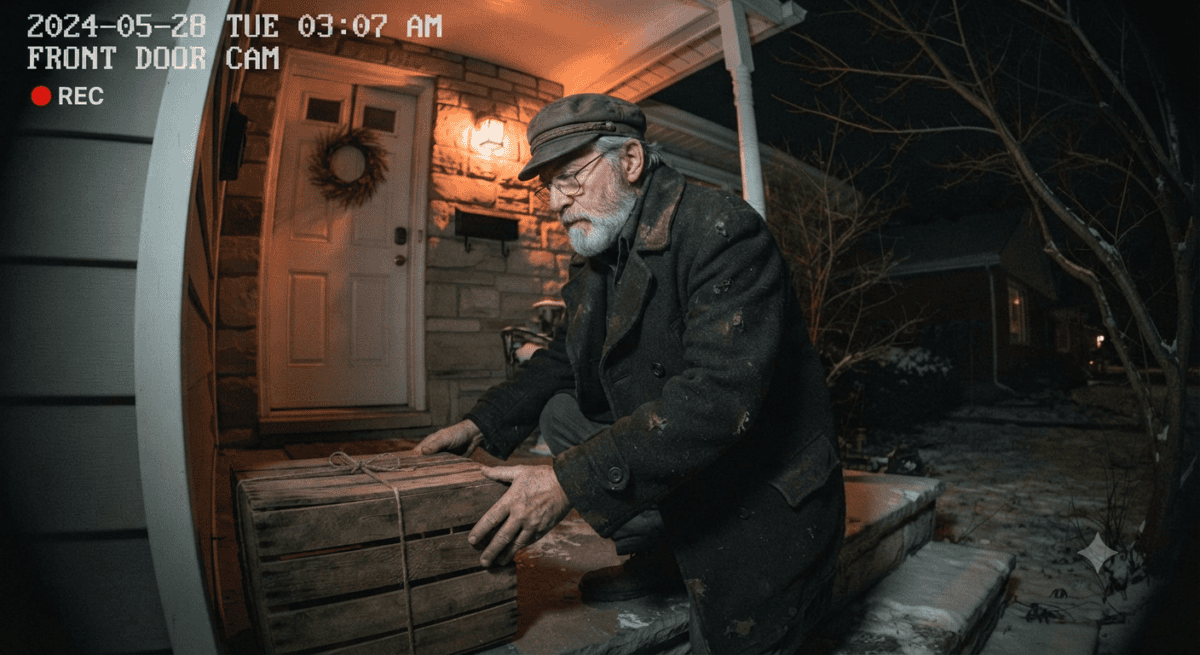
It started with the sound of pine wood scraping against concrete.
Every Tuesday morning, just before my alarm went off at six, I would walk down the stairs to let our golden retriever out into the front yard. And every Tuesday morning, sitting right beside the welcome mat, was a small, unpainted wooden crate.
The first time it happened, my husband, Mark, and I assumed it was a delivery error. There was no shipping label, no return address, and no packing slip tucked beneath the slats. Inside, nestled in shredded brown paper, were six heirloom tomatoes, two jars of amber honey, and a bundle of fresh rosemary tied with butcher’s twine. We asked the neighbors on either side of us if they were missing a farm share box. Both shook their heads. By Thursday, we decided the produce would go to waste if we left it sitting on the counter, so we ate the tomatoes on toast and stirred the honey into our tea.
Then the next Tuesday rolled around. There it was again. Same rough pine slats. Same brown paper. This time, it held crisp Honeycrisp apples, a small sack of fingerling potatoes, and a loaf of dense, seeded sourdough bread still faint with the warmth of an oven.
We had only lived in the house on Elmwood Lane for four months. It was a sprawling, hundred-year-old Craftsman with deep wraparound eaves, original oak wainscoting, and a backyard bordered by a thick wall of mature arborvitae hedges. We had bought it from an estate sale after the previous owner, a woman named Evelyn Vance, passed away at the age of ninety-two. During the closing process, the realtor had mentioned in passing that Evelyn had lived in the house for nearly seventy years, raising three children there before her husband died in the late nineties. She had spent her final two decades living alone, fiercely independent until the very end.
When the third Tuesday brought a crate filled with Bartlett pears, sweet corn, and a jar of spiced peach preserves, Mark and I stopped treating it like a clerical mistake. Someone was deliberately leaving food on our porch in the dead of night.
Our neighborhood was quiet, the kind of established, tree-lined enclave where people waved while mowing their lawns but largely kept to their own routines. The only person who stood out was Arthur Pendelton, who lived directly across the street in a narrow, two-story colonial with peeling gray paint and overgrown boxwoods. Arthur was in his late seventies, thin as a rail, with a shock of white hair and a perpetual slight stoop. He never came to the block parties. He never lingered by the mailboxes. Whenever Mark or I raised a hand to wave at him while he was tending to the sprawling vegetable garden in his side yard, Arthur would give a stiff, barely perceptible nod before turning his back and disappearing inside his garage.
Naturally, our minds wandered toward him, though it made no sense. Why would a man who couldn't even bring himself to say good morning be sneaking across the street in the middle of the night to leave gourmet groceries on our doorstep?
By the fourth week, curiosity had turned into mild unease. Our old brass doorbell had stopped working years before we moved in, and we hadn't bothered to replace it yet. That Saturday, Mark drove to the hardware store, bought a smart video doorbell with night vision and motion-activated alerts, and spent the afternoon wiring it into the doorframe.
We didn't tell anyone we installed it. We didn't put the little blue security sticker in the front window. We simply calibrated the motion zone to cover the front steps and waited for Tuesday.
On Monday night, we went to bed at our usual time, around ten-thirty. I set my phone on the nightstand with the volume turned up, fully expecting to be woken up by a chime. Sleep came fitfully. Every creak of the settling floorboards made me glance at the dark screen of my phone.
At exactly 3:04 AM, the device buzzed violently against the wood of the nightstand.
I grabbed it, squinting against the sudden glare of the screen, and tapped the notification. Mark woke up beside me, leaning over my shoulder as the live feed buffered and snapped into sharp, monochrome infrared focus.
The street was completely empty. The streetlights cast long, pale cones across the asphalt, and a light autumn breeze stirred the dry leaves along the curb. For a few seconds, nothing moved. Then, from the shadows at the edge of the driveway across the street, a figure emerged.
It was Arthur.
He was wearing a heavy plaid flannel jacket over dark trousers and a worn wool cap pulled low over his ears. In both hands, he carried one of the familiar wooden crates. He didn't rush, and he didn't look around nervously like someone trying to avoid being caught. Instead, he walked with a slow, practiced steadiness, navigating the uneven sidewalk cracks without even looking down at his feet.
He crossed Elmwood Lane, stepped onto our brick walkway, and climbed the four wooden steps to our porch. Because of the wide overhang of the roof, the infrared light caught the deep lines of his face with startling clarity. He looked exhausted, his shoulders slightly hunched against the chill, yet his expression was entirely serene.
Arthur knelt down beside the welcome mat—not easily, taking a moment to brace one hand against his knee—and gently set the crate on the concrete. He reached inside, adjusted the brown paper so the contents wouldn't shift, and smoothed down the corner of a folded piece of parchment tucked into the side. Then he stood up, paused for three full seconds staring at our front door, and raised two fingers to the brim of his wool cap in a quiet, solitary salute.
He turned around, walked back down the steps, and vanished into the darkness of his own driveway. The entire interaction had lasted less than forty seconds.
Mark and I sat in the dark bedroom, staring at the frozen thumbnail on my phone screen. There was nothing sinister about the footage. There was no malice in his posture, no intrusion, no threat. If anything, watching him struggle slightly to kneel down and set that box on our concrete made my chest ache with a sudden, unexpected tenderness.
At six-thirty that morning, I put on my coat, opened the front door, and picked up the crate. Inside were late-season figs, a bundle of Swiss chard, a jar of pickled beets, and a small paper bag of roasted chestnuts. The empty crate from the previous week, which Mark had left tucked behind the porch pillar the night before just to see what would happen, was gone. Arthur had swapped them out seamlessly.
I carried the crate into the kitchen, set it on the island, and looked at the folded piece of parchment Arthur had adjusted on the video. Usually, there was no paper at all. I pulled it free from the brown shredded filler and unfolded it on the counter.
It wasn't a letter. It was a faded, laminated recipe card, yellowed with age and stained at the corners with what looked like old butter or oil. Written in neat, looping cursive was a recipe for spiced pear and walnut bread. At the bottom, in a different, heavier handwriting—block letters written in blue ballpoint pen—was a single date: October 14, 2006.
That afternoon, instead of waiting until the weekend, I baked the bread using the pears from the week before and the walnuts from our pantry. When it came out of the oven, the entire downstairs smelled of cinnamon, toasted nuts, and brown sugar. I wrapped half the warm loaf in a clean linen dish towel, walked out our front door, and crossed the street.
I had never stood on Arthur’s porch before. Up close, the house looked even more weathered, though the porch itself was swept spotless. A row of terracotta pots lined the railing, filled with dried herbs and dormant perennials. I took a deep breath and knocked softly on the storm door.
For a long moment, there was no sound from inside. I was just about to turn around and leave the bread on his patio chair when the heavy wooden inner door swung open.
Arthur stood there in a faded crewneck sweater, holding a pair of reading glasses in one hand. When he saw me standing on his mat, holding a towel-wrapped bundle, his eyes widened slightly. His gaze dropped from my face to the linen towel, and then drifted past my shoulder toward our house across the street.
"Hello, Mr. Pendelton," I said, keeping my voice gentle and unhurried. "I'm Sarah. From across the street. I wanted to bring you some of this before it cooled down."
Arthur didn't reach for the bread right away. He looked at me with a mixture of caution and quiet resignation, as if he knew the jig was up. "You put up one of those little cameras," he said. His voice was gravelly, rough from disuse, like hinges that hadn't been oiled in a season.
"We did," I admitted honestly. "We didn't know who was leaving the food, and we wanted to make sure everything was okay. I didn't mean to pry."
He let out a long, slow breath, his shoulders dropping an inch. He opened the storm door and stepped back, gesturing weakly toward the small foyer. "You might as well come in for a minute. You're letting the cold air in, and my knees don't care much for standing in a draft."
Inside, Arthur’s house was nothing like its weathered exterior. It was warm, immaculately tidy, and smelled faintly of cedar and brewing coffee. The living room walls were lined with bookshelves sagging under the weight of hardcovers, gardening almanacs, and framed black-and-white photographs.
He took the warm bread from my hands, unwrapped the corner of the towel, and looked down at the golden crust. A faint, almost imperceptible smile touched the corners of his mouth. "You used Evelyn’s recipe," he murmured.
"It was tucked into the crate this morning," I said, standing near the edge of the braided rug. "I figured it belonged to the woman who owned our house before us."
Arthur nodded slowly. He walked over to a small side table, set the bread down, and motioned for me to sit in a worn leather armchair while he lowered himself onto the sofa across from me.
"Evelyn and my wife, Clara, were best friends for forty-five years," Arthur began, staring down at his hands. "Before you and your husband moved in, before the realtors painted the shutters and paved over the side path, those two women ran this entire block. If someone was sick, they brought soup. If someone had a baby, they brought casseroles. They shared everything. Seeds, recipes, books, tools."
He paused, his thumb tracing the seam of his trousers. "Clara passed away in the autumn of 2006. Pancreatic cancer. It happened fast—less than four months from the diagnosis to the funeral. By the end, she couldn't keep anything down, and I was spending every waking hour at the hospital or sitting by her bed. I stopped going into the garden. Everything just went to weeds."
I sat quietly, letting him take his time.
"The week after Clara died," Arthur continued, his voice steadier now, "I was sitting right here in this chair, staring at the wall, wondering what on earth I was supposed to do with the rest of my life. There was a knock at the door. It was Evelyn. She was holding a wooden crate—that exact same pine crate you found on your porch this morning. Her husband, Walter, had built a dozen of them out in his workshop back in the eighties."
Arthur looked up at me, his pale blue eyes sharp with memory. "Inside that crate, Evelyn had packed tomatoes from her own vines, a loaf of that pear bread you just baked, and two jars of honey. She set it on my table, looked me dead in the eye, and said, 'Arthur, you are a stubborn old man, and if I don't feed you, you're going to wither away just to spite me. Every Tuesday, you're getting a crate. Don't argue with me.'"
I felt a lump form in my throat. "And she kept bringing them?"
"Every single Tuesday for fourteen years," Arthur said softly. "Through blizzards, through heatwaves, through my hip replacement in 2012. Even after her own hands got too a


