
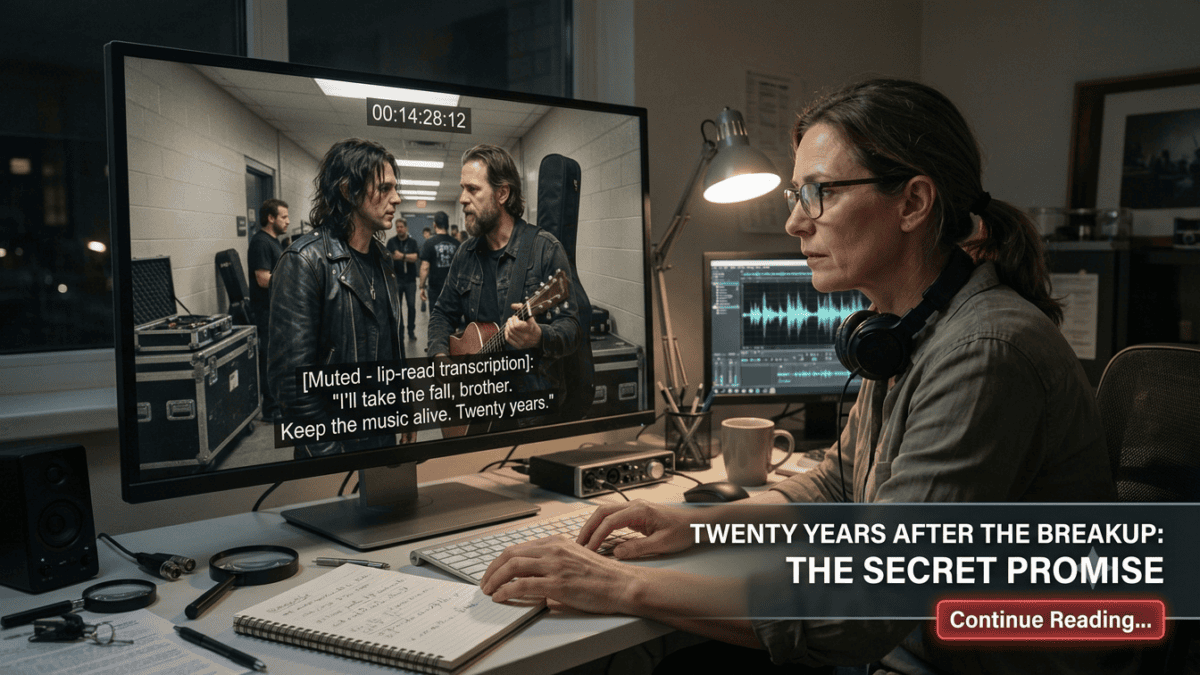
For twenty years, music fans argued over fifteen seconds of silent film. It appeared halfway through a grainy backstage documentary from the late nineties. The camera sat perched on a road case near a scuffed concrete wall. Two men stood inches apart while muffled bass thumped through the floorboards. One was the band's gritty rhythm guitarist and primary songwriter, known for razor-sharp lyrics and late-night studio marathons. The other was the lead vocalist and co-founder, whose soaring voice once filled sold-out arenas from Manchester to Melbourne. No audio track existed on that reel. A technician had bumped the gain switch or a tape reel had run dry right before the clip began. For two decades, the internet treated those fifteen seconds like a Rorschach test of rock-and-roll betrayal. Some fans swore the singer was sneering about royalties. Others claimed the guitarist was issuing an ultimatum over a solo spot or a tour bus bunk. Magazine cover stories built entire mythologies around their supposed feud. Every reunion rumor began and ended with that silent hallway clip. Then a specialist who reads lips for courtrooms and historical archives examined the frames under high magnification. What she found did not look like a blowout fight or a greedy demand. It looked like a quiet, selfless promise made under unbearable pressure, kept secret for twenty years because admitting the truth would have ruined the very thing both men were trying to save.
To understand why those fifteen seconds mattered so much, you have to remember what the band meant in their prime. They formed in a damp basement rehearsal room when both founders were barely out of their teens. They wrote songs about train stations at dawn, broken payphones, and the strange ache of growing up in a town where nothing changed except the weather. Their first record sold modestly out of the trunks of cars and independent record shops. Their third album became a generational touchstone. By their fifth year together, they were headlining festivals in pouring rain with tens of thousands of people singing every word back at them. To outsiders, they looked invincible. Inside the tour bubble, exhaustion was eating them alive. Road fatigue turns minor friction into wildfire. When you spend three hundred nights a year in vans, green rooms, and fluorescent hotel corridors, every habit becomes a test of patience.
By the autumn of that final tour, cracks were showing everywhere. The band had been on the road for fourteen months with barely a week off between legs. Sleep came in jagged two-hour stretches between soundchecks and late-night interviews. The singer's vocal cords were chronically strained, forcing him to rely on cortisone sprays and vocal rest between shows. Meanwhile, the guitarist was carrying the weight of the arrangements, the mixing notes, and a quiet personal crisis back home that he rarely mentioned to the crew. Rumors of tension had started leaking into the music press. A missed cue in Chicago, a curt wave at an airport terminal, a canceled press junket in Berlin. Each small moment was stitched together by observers into a narrative of creative implosion. When the band announced an indefinite split three weeks later, nobody was surprised, even if millions of listeners felt a sudden hollowness when the news broke.
The documentary crew had been filming behind the scenes for months, hoping to capture raw honesty rather than polished press-kit smiles. Most of their footage showed tuning guitars, eating cold takeout on folding chairs, and joking with stagehands. The fifteen-second clip in question came from a night in a mid-sized theater after an encore that had run twenty minutes past curfew. Sweat soaked through both men's shirts. Stage dust clung to their boots. In the footage, the guitarist walks over to the singer near a heavy fire door. He places a hand briefly on the singer's forearm. Their mouths move. Their expressions shift from tense exhaustion to a strange, heavy calm. A stage manager walks past in the background, unaware anything historic is happening. Then the reel cuts to black.
For years, viewers played that clip on repeat, slowing it down to half speed and zooming in on every jaw clench and raised eyebrow. Without sound, human brains rush to fill the silence with drama. Anger is easy to project onto tired faces. Resentment looks a lot like grit when you strip away the voice. Music blogs ran frame-by-frame breakdowns pointing to a pointed finger or a tight nod as proof of an irreconcilable split. Even longtime band associates stayed quiet when asked about that hallway moment. Loyalty in tight-knit groups often means keeping doors closed long after the tour ends. Nobody wanted to litigate old wounds in public, and both founders moved into separate creative orbits. One produced records for younger artists and scored independent films. The other stepped back from touring for years, painting, writing short stories, and living a quieter life away from stadium spotlights.
The turning point came when a historical documentary team licensed the original vault reels for a retrospective project. Rather than relying on guesswork or sensationalism, the producers brought in a forensic lip-reading specialist experienced in analyzing low-resolution archival footage. Reading lips without audio is demanding work. Cameras capture angles rather than flat profiles, lighting shifts across frames, and fast consonants blur when subjects turn their heads. A careful analyst looks for vowel shapes, tongue placement, jaw movement, cadence, and facial context across dozens of consecutive frames before offering a reading. She worked slowly, comparing frame sequences alongside notes from people who knew how each man spoke under stress.
When the analysis came back, the room went quiet. There was no shouting match in those fifteen seconds. There was no demand for money, no threat to quit on the spot over ego, and no cold shoulder. Instead, the guitarist was speaking softly, almost urgently, while looking straight into the singer's eyes. According to the lip-reading reconstruction, the guitarist told him to stop pushing his voice through the pain, to let the band take the blame for stepping away, and to protect his health without worrying about letting the fans down. He promised to shoulder the public fallout alone if needed, telling his friend that a wrecked voice and a broken spirit were too high a price to pay for another encore. The singer hesitated, shook his head slightly as if refusing charity, and then mouthed a quiet agreement before offering a vow of his own in return: that neither of them would ever trash the other's name in public, no matter what stories got printed after the curtain fell.
Think about how radical that exchange looks against twenty years of folklore. For two decades, people assumed the breakup came from selfishness. They pictured two big egos colliding until one walked out. Seeing the exchange as an act of mutual protection flips the entire story upside down. The guitarist saw a friend running himself into the ground night after night, masking physical strain with adrenaline and pride. Stopping the machine required someone willing to take the hit for pulling the emergency brake. In the music business, stepping away at your peak invites accusations of flakiness, greed, or arrogance. The guitarist knew the press would spin a sudden exit as a meltdown. He was willing to absorb that narrative so his co-founder could heal without the crushing weight of feeling like he had failed the crowd.
And the second half of that silent promise explains why the truth stayed buried for twenty years. Both men understood that explaining the real reason for the split at the time would have invited intrusive scrutiny into private health struggles and personal vulnerability. Worse, if they tried to correct every rumor one by one, they would stay trapped inside the drama they were trying to leave behind. Keeping quiet was not about hiding malice. It was about keeping peace. Over the years, whenever interviewers pressed for dirt or asked who was to blame for ending the run, both men stuck to brief, diplomatic answers. Fans read those polite answers as coldness or unresolved bitterness. In reality, both men were honoring a pact made in a noisy hallway twenty years earlier.
There is something deeply moving about realizing how often we misread silence. We live in an era obsessed with hot takes, instant explanations, and dramatic villains. When we see two people part ways abruptly, we look for a smoking gun. We assume there had to be a betrayal, a blowup, or a hidden agenda. Yet real life is frequently quieter and more complicated than the headlines suggest. Sometimes two people care enough about each other to take the harder path and say very little about it. Carrying a secret promise for two decades takes a different kind of strength than standing on a stage in front of roaring crowds. It takes restraint when people put words in your mouth. It takes grace when strangers misunderstand your motives year after year.
Looking back at that fifteen-second clip now changes how those old songs sound, too. Lines that once sounded like bitter farewells or sharp critiques take on new shading when you picture two tired friends looking out for each other behind a stage door. Art often outlives the moment it was made, gathering new meaning as time passes and hidden context comes to light. Even without hearing a single syllable from that hallway, the story of what happened there reminds us that loyalty is often tested far from the spotlights, in small choices nobody else sees at the time. A quiet promise kept for twenty years does not need volume to carry weight. Sometimes the strongest thing two people ever say to one another happens in the quiet between the noise.


