
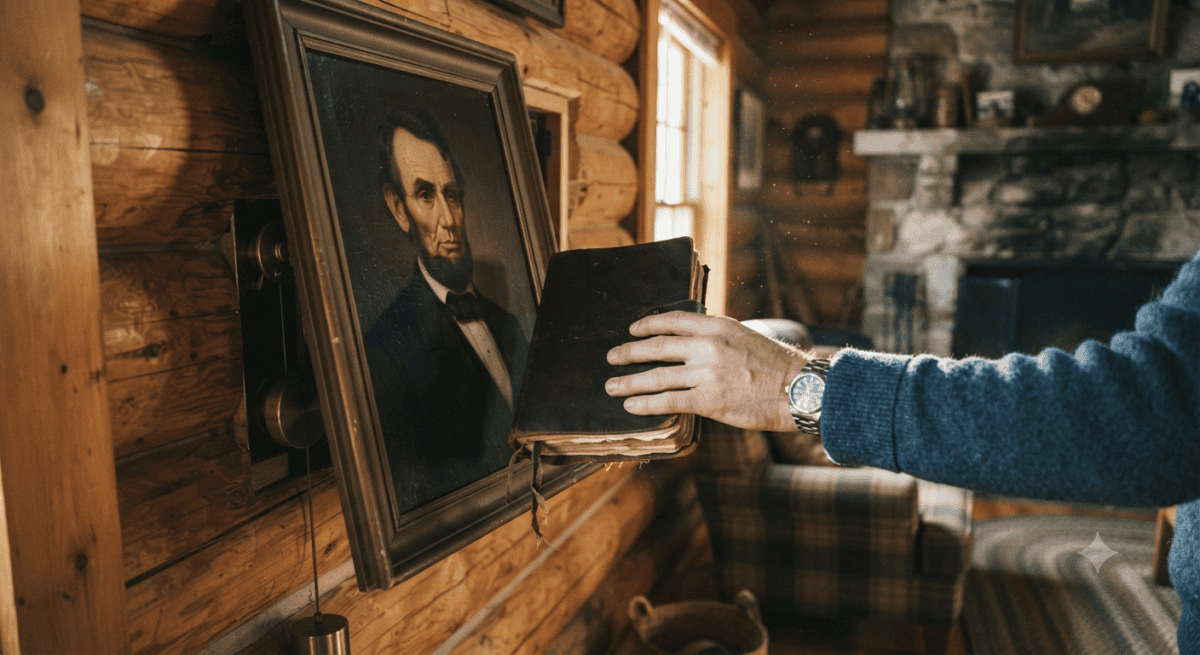
It started with a degree or two of tilt. Every single morning, I would walk out of the bedroom with my coffee, glance at the stone fireplace, and notice that the heavy oil portrait hanging above the mantel was crooked.
At first, I blamed the mountain air. My wife, Claire, and I had rented a remote timber cabin high in the Blue Ridge Mountains for two weeks in late October. The structure was old, built from massive hand-hewn chestnut logs that seemed to groan and settle whenever the temperature dropped below freezing. When you live in a house made of ancient wood, things shift. Floors creak. Doors stick. Pictures lean.
So on that first Tuesday morning, I simply set my mug down on the hearth, reached up with both hands, and straightened the frame. It was heavier than I expected. The frame was solid walnut, deeply carved with tarnished gilt trim, and the canvas inside depicted a stern-looking man from the late nineteenth century. He had a thick, graying beard, dark eyes that seemed to follow you across the room, and wore a heavy wool coat buttoned up to his collar.
I pushed the right side up until the bottom edge looked parallel with the rough-cut mantel beam, stepped back, and nodded. Problem solved.
Except it was not solved. On Wednesday morning, the painting was tilted again. The exact same angle. The left side dipped down toward the stone, while the right side rose up.
I looked at Claire, who was standing by the kitchen counter. Did you bump the wall last night? I asked.
She looked over her shoulder and frowned. Why would I be near the fireplace in the middle of the night? Maybe it is a draft from the chimney.
I walked over and checked the flue. It was tightly shut. I tested the walls around the mantel, pressing my palms against the chinking between the logs. Everything was solid. No wind was getting through here. The cabin doors were deadbolted from the inside every night, and the windows were painted shut on the upper sash and latched tightly on the lower. Nobody was coming in, and nothing was vibrating the walls. We were three miles up a gravel logging road with no neighbors, no passing trucks, and no train tracks within twenty miles.
I straightened the portrait again. This time, I paid closer attention to how it hung. It felt unusually rigid against the wall, almost as if it were mounted on a hinge rather than dangling from a standard picture wire. When I pushed the bottom corner, there was a faint, metallic click deep behind the plaster, followed by a soft, muffled thud.
I froze. Claire noticed my expression and walked over. What is it?
Did you hear that? I asked, keeping my hands on the walnut frame.
Hear what?
I tilted the left side down, mimicking the crooked angle I had found that morning. Nothing happened. Then I pushed it back to level. Again, there was that tiny, mechanical click inside the wall.
By Thursday morning, I was no longer thinking about settling foundations or mountain drafts. When I walked into the living room at six in the morning, the portrait was tilted at that exact same angle. Left side down, right side up. It was as if the painting wanted to rest in that position, or as if something behind the wall was slowly pulling it back down over the course of the night.
Claire was still asleep, so I grabbed a flashlight from the utility drawer and pulled a sturdy wooden dining chair over to the hearth. I climbed up, gripped both sides of the heavy walnut frame, and lifted straight up.
It did not budge. Standard picture hooks allow you to lift a frame right off the nail, but this frame was anchored. I tried sliding it to the left, then to the right. When I pushed it firmly to the right while tilting the bottom left corner downward, something gave way.
A heavy iron latch released with a sharp clack. Suddenly, the entire portrait swung outward toward me like a small cabinet door, pivoted on heavy brass hinges concealed along the right edge of the frame.
I nearly lost my balance on the chair. Catching myself against the stone chimney, I shone the flashlight into the dark recess behind the canvas.
It was not solid log or plaster. Carved directly into the massive central chimney breast, insulated from the flue by thick courses of brick and mortar, was a square alcove about eighteen inches wide and two feet tall. Inside the back of the portrait frame, I could see the mechanism that had been driving me crazy for three days. It was a nineteenth-century counterweight system. A braided iron cable ran from the latch over a small brass pulley recessed into the stonework, connected to a cylindrical lead weight hanging inside a narrow vertical channel. Over the decades, the grease on the pulley had dried out, and the tension on the spring latch had weakened. Every time I pushed the frame level, the catch barely held. Slowly, over seven or eight hours of temperature changes in the cabin, the lead weight would pull the cable down, tripping the worn latch and causing the frame to sag to the left by half an inch.
It was an ingenious piece of hidden carpentry, designed to keep the secret compartment tightly sealed without a visible keyhole. And sitting neatly on the slate floor of that hidden alcove was a single object.
I reached in and pulled it out. It was a thick, leather-bound ledger, roughly the size of a modern hardcover novel, wrapped twice with a faded strip of rawhide. The leather was dry and cracked at the spine, smelling faintly of woodsmoke, cedar, and old paper.
I climbed down from the chair, closed the portrait until the worn latch clicked back into place, and carried the book over to the oak dining table. By the time Claire came out of the bedroom twenty minutes later, I had already untied the rawhide and carefully opened the cover.
What on earth is that? she asked, looking at the weathered volume spread out in front of me.
It was behind the painting, I told her, pointing toward the fireplace. There is a hidden safe built into the chimney.
We spent the rest of the morning and most of the afternoon sitting side by side at that table, gently turning the brittle, yellowed pages. The handwriting inside was executed in dark iron-gall ink, written with a steel nib pen in the tight, disciplined cursive of the eighteen-eighties. On the inside cover, written in bold strokes, was a name and a date: Thomas Vance, October 1884.
According to the brief informational binder the property management company had left on the coffee table, Thomas Vance was the original homesteader who built the cabin. The local history blurb described him as a quiet, reclusive timber surveyor and trapper who lived alone on the ridge until his death in 1912, leaving behind no heirs and very little record of his life.
The journal in front of us told a much richer, far more complex story.
Vance was not merely a solitary trapper. In the autumn of 1884, he had been hired by a consortium of northern investors to survey the mineral and timber rights across three thousand acres of the surrounding Blue Ridge watershed. The entries from October and November of that year were filled with meticulous measurements, compass bearings, sketches of creek beds, and notes on old-growth chestnut and white oak stands.
At first, the writing was purely professional. Vance recorded the weather, the game he shot for supper, and the progress of his stone chimney. He mentioned building the hidden alcove specifically to protect his survey maps and silver coin from wandering timber thieves who occasionally passed through the mountain gaps.
By December of 1884, however, the tone of the journal shifted dramatically.
In his survey of the upper hollow—a steep, rocky gorge just two miles north of the cabin—Vance had found something the northern investors were not expecting. He had discovered a rich seam of high-grade mica and an even more promising vein of silver-bearing galena ore running directly beneath a tract of land owned by four local farming families.
The investors had sent Vance into the mountains with strict instructions. If he found valuable minerals, he was to keep the discovery entirely secret, file a fraudulent low-value agricultural assessment, and allow the company's land agents to buy out the local families for pennies on the acre before winter ended.
Vance wrote about his dilemma with raw, agonizing honesty. He needed the surveyor's fee to pay off debts in Virginia, and he knew that crossing a powerful syndicate of industrialists could ruin him, or worse. Yet he had spent the autumn trading with those very families in the valley below. He knew their names. He had eaten supper at their tables, traded salt and coffee for dried apples and wool socks, and watched their children haul water from the creeks. If he signed the false survey, those families would lose land they had cleared by hand over three generations, cheated out of a fortune that rightfully belonged to them.
In January 1885, Thomas Vance made his choice.
He did not send the fraudulent report. Instead, he spent three weeks drafting two complete, accurate sets of mineral maps and assay estimates. On the night of February second, during a heavy snowstorm, he rode his mule down into the valley and delivered one set of maps—along with a handwritten letter explaining the true value of the ridge—directly to the elders of the four farming families.
The second set of maps, along with the silver coins the syndicate had paid him as an advance, he locked inside the chimney alcove behind his portrait. He wrote in the journal that if the company men came looking for him, or if he met with an unexpected accident on the mountain trails, the truth would remain safely hidden in the stone until someone honest found it.
As Claire and I turned to the final pages of the ledger, dated spring of 1886, we learned how the story ended. The valley families had banded together, used Vance's maps to secure fair legal representation in the county seat, and forced the northern syndicate to negotiate legitimate mineral leases. The families kept their farms and prospered for generations. The investors, furious at having their scheme exposed, fired Vance, blacklisted him from further survey work, and spread rumors in town that he was an unreliable eccentric.
Vance never left the ridge. He stayed in the cabin he had built, living quietly off the land, seemingly at peace with the price he had paid for his conscience. His final entry, written in a steady hand in May of 1886, simply read: The spring water runs clear, the chestnut trees are in bloom, and a man sleeps well when he owes no debt to his own soul.
We did not keep the journal. When our two weeks in the mountains ended, we contacted the local historical society in the county seat down in the valley. When we met with the archivist and laid Thomas Vance's leather ledger on her desk, she was nearly speechless. She told us that four of the oldest, most prominent families in the county still credited an unnamed nineteenth-century surveyor with saving their ancestral farms, though no one had ever been able to prove who had warned them or why he had done it.
Before we locked the cabin door for the last time and drove down the gravel road toward home, I stood in front of the fireplace one more time. I checked the portrait of Thomas Vance. The counterweight had been gently oiled with a drop of sewing machine oil we found in a kitchen drawer, and the brass latch now held firm and true.
The frame sat completely level against the rough timber wall. After a hundred and forty years, the old surveyor no longer needed to tilt his picture to get someone's attention. His work was finally finished.


