
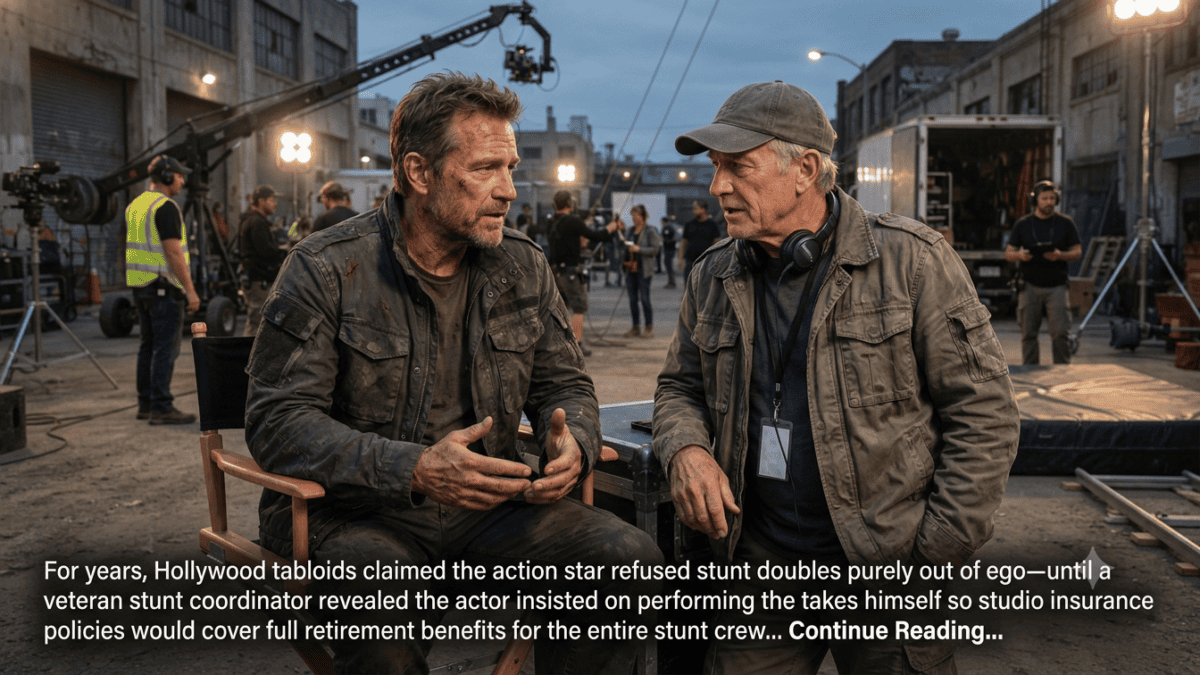
For years, Hollywood tabloids painted him as a reckless egomaniac. Every entertainment magazine in the grocery store checkout aisle had the same tired headline. They said he was obsessed with his own image. They claimed he refused to let stunt doubles step in front of the camera because he wanted all the glory for himself. Critics called him stubborn, arrogant, and impossible to work with on a film set.
To the outside world, the narrative seemed completely believable. Movie stars are famous for having massive egos. When an actor insists on jumping off a moving train, hanging from the side of a helicopter, or driving a muscle car through a wall of fire, the public assumes it is all about vanity. People figured he just wanted his face clearly visible in the wide shots so audiences would know how tough he was.
Even some directors complained in off-the-record interviews. They said his refusal to use a stunt double slowed down production and gave studio executives gray hair. Insurance companies supposedly threatened to pull funding from his movies because the lead actor was putting himself in constant physical danger. Every time he limped onto a late-night talk show with a bruised shoulder or a wrapped wrist, the host would laugh and shake their head at his supposed vanity.
The actor never corrected them. When reporters asked why he refused to let trained professionals take the hits, he just shrugged and gave a polite, rehearsed answer about wanting to give the audience the most authentic experience possible. He took the criticism in stride, smiled for the cameras, and walked away. For nearly two decades, that was the entire story.
Then, at a quiet industry luncheon honoring behind-the-scenes film workers, a veteran stunt coordinator stepped up to the microphone and shattered that myth forever.
The coordinator had worked alongside the actor on more than a dozen major action films over twenty years. He was a man who had broken dozens of bones, survived countless high-speed crashes, and spent his entire adult life making famous people look fearless on screen. When he spoke, the entire ballroom went silent. He told the room that everything the press had written about the star's ego was not just wrong, it was the exact opposite of the truth.
To understand what the actor was actually doing, you have to understand how the Hollywood machine treats the people who take the falls.
In the film industry, stunt performers are the invisible backbone of every blockbuster. When a movie makes hundreds of millions of dollars at the global box office, the lead actors, directors, and producers walk away with massive paydays and backend profit deals. Meanwhile, the stunt men and women who risked paralysis or worse to make those thrilling sequences possible are treated like disposable day players.
For decades, the financial structure of stunt work has been brutal. Most stunt performers are hired on short-term, daily, or weekly contracts. They get paid a flat rate for the days they are actively on set taking hits, crashing cars, or falling off buildings. Once their specific scene is wrapped, their paycheck stops.
More importantly, qualifying for full union health insurance and a livable retirement pension in Hollywood requires hitting a strict threshold of documented working days and earnings every single year. If a stunt performer gets injured in March and cannot work for the next six months, they do not just lose their income. They risk losing their healthcare coverage right when they need surgery and physical therapy the most. And if they fall short of their annual hours, another year of pension credits vanishes into thin air.
Studios know this system inside and out, and they routinely exploit it to keep production budgets low.
A common studio tactic is to hire a minimal skeleton crew of stunt performers for just one or two days of filming. They rush through the most dangerous shots, pack up the safety mats, and send the stunt team home without a second thought. Another tactic involves rewriting contracts at the last minute to classify dangerous physical work as standard acting, which allows producers to bypass union rules regarding stunt residuals and hazard pay.
When this particular action star reached the height of his fame in the late nineties, he started paying close attention to the budgets and call sheets on his own movies. Because he was bringing in massive box office numbers, he had leverage that almost no other person on set possessed. He realized that the studio executives were terrified of losing him, and he decided to use that fear as a weapon to protect his crew.
Here is how the loophole worked, and why the actor insisted on doing the stunts himself.
Whenever a movie production schedules a major stunt sequence involving the lead star, the studio's insurance underwriters go into overdrive. If a regular stunt double is performing a high-fall or a high-speed car chase, the studio can cut corners on safety setups and keep the stunt crew on a bare-bones daily rate. If the stunt double gets hurt, the studio simply calls the union hall the next morning and hires a replacement. The cameras keep rolling, and the studio loses zero money.
However, if the lead actor — the multi-million-dollar star whose face is on every billboard and whose name financed the entire project — insists on performing the stunt himself, everything changes instantly.
If the lead actor gets injured, production shuts down completely. A single day of delayed filming on a major studio picture costs hundreds of thousands of dollars in crew wages, equipment rentals, and location fees. If the star is out for a month, the studio faces tens of millions of dollars in losses.
Because of this massive financial risk, the studio's insurance policies enforce strict, non-negotiable mandates whenever the star steps in front of the camera for an action sequence. First, the insurance company requires a full, top-tier stunt team to be hired for the entire duration of the shoot — not just for a single day, but from the first week of pre-production rehearsals all the way through the final day of wrap.
Second, the actor used his contract negotiations to tie his own stunt participation directly to the crew's employment terms. He told the studios that if they wanted him to do the dangerous physical work that sold tickets, every single member of his stunt team had to be placed on full, run-of-show contracts.
Run-of-show contracts meant the stunt performers were paid every single week the movie was in production, whether they were taking a fall that day or simply standing by during a quiet dialogue scene. Those guaranteed weeks of steady pay ensured that every stunt performer on his set easily cleared the annual earnings threshold required for full family health insurance and maximum retirement pension credits.
But he did not stop there.
According to the veteran stunt coordinator, the actor also demanded that the studio's high-limit production insurance policy cover his stunt doubles and riggers under the exact same medical and disability terms as the above-the-line talent. Normally, if a stunt performer suffers a career-ending injury on set, they are left fighting through red tape for basic workers' compensation, which covers only a fraction of their lost wages and often denies long-term rehabilitation care.
By refusing to use a double during the filming of the primary takes, the actor forced the studio to keep the entire stunt department on the clock for weeks of rehearsals, safety testing, and rehearsals of the rehearsals. The stunt double was still there every single day, testing the rigging, measuring the fall distances, adjusting the crash pads, and working out the choreography alongside the star. The double got paid for the entire run of the movie, received full screen credit, and never had to take the final, bone-crushing impact when the cameras rolled at full speed.
The actor took the bruises so his stunt double could go home to his kids without a concussion and still collect a full paycheck.
The veteran coordinator shared a specific memory from a winter shoot in the mountains. They were filming a sequence where the lead character had to slide down a steep, icy embankment and leap across a narrow gorge onto the back of a moving flatbed truck. It was a brutal, unforgiving stunt with zero margin for error. If the timing was off by half a second, the performer would slam straight into the steel tailgate or drop forty feet onto jagged rocks.
The studio executives wanted to bring in a freelance stuntman for two days, film the shot quickly, and move on to the next location. They offered the freelance guy a flat fee of three thousand dollars with no residual payments and no extended contract.
When the actor found out, he walked into the producer's trailer and shut the door. Witnesses outside could hear him yelling through the thin walls. He flatly refused to step onto the set until the studio hired a twelve-person stunt team for the entire six-week location shoot, put them all on full union scale with pension contributions, and upgraded the medical evacuation helicopter on standby from a basic transport unit to a full trauma-equipped aircraft.
The producers folded within two hours. They had no choice. Without him, there was no movie.
Then, when the day came to shoot the leap onto the truck, the stunt double stepped up to the mark, ready to take the hit he was being paid for. The actor walked over, put a hand on his shoulder, and told him to step back. He looked the stuntman in the eye and said that the guy had a two-year-old daughter waiting at home, while he himself had no kids and the best doctors money could buy. He strapped on the hidden padding, waited for the director to call action, and made the jump himself.
He nailed the landing on the second take, though he cracked two ribs against the side of the truck bed in the process. He never mentioned the cracked ribs to the press. When a reporter asked him about the scene during the press tour six months later, he just smiled and said he liked doing his own stunts because it kept him in shape.
The coordinator revealed that this pattern repeated itself across more than twenty years of filmmaking. Every time the actor signed on to a new franchise or standalone thriller, he brought the same core group of stunt coordinators, riggers, drivers, and utility performers with him. Over the course of two decades, dozens of career stunt workers were able to buy homes, put their children through college, pay off medical bills, and retire with full, dignified pensions solely because this actor insisted on keeping them on his payroll and shielding them with his own star power.
Even when he grew older and his body began to show the wear and tear of decades of hard landings, he refused to change his approach. His close friends begged him to slow down and let the younger guys take the hits. His agents warned him that one bad fall could end his career and cost him tens of millions of dollars in future endorsements.
His response was always the same. He reminded them that he already had more money than he could spend in three lifetimes, while the men and women holding the safety cables and driving the camera cars were working paycheck to paycheck to support their families. If putting his own body on the line was the only way to force multi-billion-dollar studios to treat blue-collar film workers like human beings, then he was going to keep jumping off buildings until he could not walk anymore.
When the veteran coordinator finished speaking at that industry luncheon, the room was dead silent for several seconds before erupting into a standing ovation that lasted nearly five minutes. Many of the older stunt performers in the audience were openly weeping. For years, they had watched the media mock their friend as a narcissistic thrill-seeker, bound by non-disclosure agreements and


