
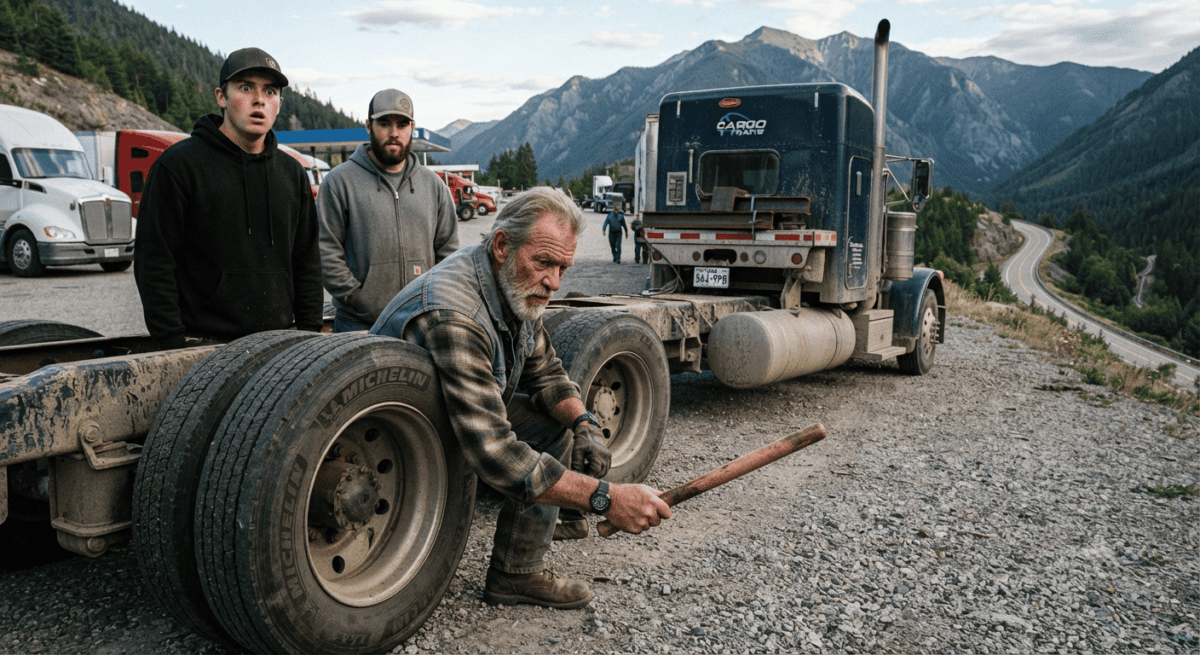
At high elevation in the Rocky Mountains, the air is thin, cold, and unforgiving. Rest stops perched near the crest of a major pass are places of quiet preparation. Drivers step down from warm cabs into the biting wind, stretch stiff backs, check mirrors, and take one last look at their rigs before committing eighty thousand pounds of steel and freight to a long, steep descent.
For years, younger drivers passing through these mountain pullouts would smile to themselves when they watched Arthur Vance make his rounds. Arthur was in his late sixties, with silver hair tucked beneath a faded cap and hands weathered by four decades behind the wheel. While younger operators walked around their trucks holding digital tire pressure gauges, infrared thermometers, or checking dashboard telemetry screens, Arthur carried an eighteen-inch stick of dense hickory wood worn smooth at the grip.
At every single stop, without exception, Arthur walked the full perimeter of his tractor and trailer. He crouched beside each wheel assembly and gave every tire two firm, deliberate raps with his wooden baton. Tap, tap. Move to the next tire. Tap, tap. Eighteen wheels, eighteen pairs of strikes.
To the newer generation of drivers raised on electronic sensors and automated diagnostics, the ritual looked like a charming relic from another era. Some assumed it was superstition. Others thought it was simply an old habit a veteran driver refused to give up, like carrying paper maps in a cab equipped with dual GPS units. A few younger drivers would chuckle quietly as they walked past toward the coffee counter, shaking their heads at the old man hitting rubber with a stick.
Arthur never argued with them. He never lectured or tried to explain himself unless someone genuinely asked. He simply listened to the tires, nodded once to himself, climbed back into his cab, and rolled out onto the highway.
That quiet routine had been shaped across millions of miles of asphalt, ice, desert heat, and mountain grades. To Arthur, a commercial truck was not merely a machine managed through dashboard warning lights. It was a living mechanical system that spoke constantly through vibration, smell, resistance, and sound. You just had to know how to listen.
One crisp October morning, the value of that old-fashioned habit became unmistakable.
The rest area sat just west of a notorious seven-mile mountain grade known throughout the trucking industry for runaway truck ramps, smoking brakes, and sudden shifts in weather. The morning sun was bright, casting long shadows across the parking lot where a dozen heavy rigs idled softly, exhaust plumes rising white in the freezing air.
Arthur stepped down from his cab with his thermos in one hand and his hickory tire thumper in the other. He was hauling a full load of canned goods bound for Denver, putting his gross vehicle weight right near the legal limit. Ahead of him lay a six-percent downgrade with sweeping curves, guardrails overlooking deep granite ravines, and little room for error.
Two bays over, a young driver named Marcus was finishing his own walk-around. Marcus was twenty-six, two years into his commercial driving career, sharp, conscientious, and proud of his late-model tractor. He had just checked his electronic tire pressure monitoring display inside the cab. Every single tire showed green. Pressures were right at one hundred pounds per square inch. Temperatures were normal.
Marcus watched Arthur begin his familiar circuit around the front steer axle.
Tap, tap.
The hickory stick struck the thick tread of the left steer tire and bounced back sharply with a crisp, bright, resonant ring. Almost like a basketball inflated to full capacity hitting concrete.
Arthur moved to the right steer tire. Tap, tap. Same bright, tight rebound. Same clean acoustic snap.
Marcus smiled slightly as he zipped his jacket against the wind. He respected older drivers, even if some of their methods seemed outdated. As Arthur walked down the driver's side toward the drive axles, Marcus walked over with a friendly nod.
Morning, Arthur, Marcus said. Heading down the big hill?
Arthur glanced up and offered a warm, weathered smile. Morning, son. Yep. Heavy load today, so I am taking it nice and easy down the grade.
Marcus gestured toward the hickory baton in Arthur's hand. You still trust that stick over the dash sensors? My rig tells me pressure and temp to the decimal point before I even unbuckle my seatbelt.
Arthur chuckled softly, not at all offended. Sensors are great tools, Marcus. Wouldn't want to run without them. They tell you how much air is inside the chamber. They tell you if the rubber is getting hot. What they do not always tell you is what the tire itself is doing on the inside.
Marcus tilted his head slightly, curious. How do you mean?
Air pressure is just air pressure, Arthur said, stepping beside the front drive axle. A tire can hold a hundred pounds of air right up until the second it comes apart. Especially if the casing has taken a hit earlier down the road and started separating between the plies.
Before Marcus could reply, Arthur swung the hickory stick against the outer tire of the forward drive axle.
Ping. Ping. The stick rebounded crisply into Arthur's hand.
He moved to the inner dual tire, reaching between the wheel openings with practiced precision. Ping. Ping. Clean and sharp.
He stepped back to the rear drive axle. Outer tire. Ping. Ping. Inner tire. Ping. Ping.
Then Arthur walked toward the trailer tandems. Two other drivers standing near the vending machines had paused to watch the interaction, amused by the contrast between the young driver with his tablet and the veteran driver tapping rubber with a piece of hickory.
Arthur reached the front tandem axle of the trailer. He tapped the outer tire. Ping. Ping. He tapped the inner tire. Ping. Ping.
He stepped two paces back to the rear tandem axle, the final set of wheels on the driver's side. He swung the baton against the outer tire.
Thud.
The sound was completely different. There was no sharp bounce. The hickory stick did not spring back into Arthur's palm. Instead, it felt almost as if he had struck a heavy sandbag or a block of dense clay. The acoustic note was flat, dead, and hollow.
Arthur froze.
Marcus heard the difference immediately. Even from six feet away, the contrast between the crisp ring of the previous tires and that dull, lifeless thud was unmistakable.
Arthur leaned in closer and struck the tire again, slightly higher on the tread face.
Thud.
No rebound. No ring.
What was that? Marcus asked, his smile fading. Sounds like it's flat.
Arthur did not answer right away. He reached into his coat pocket, pulled out a heavy brass dial pressure gauge, unscrewed the valve stem cap on that rear outer tire, and pressed the chuck firmly onto the stem.
The needle jumped cleanly to ninety-eight pounds per square inch.
Marcus stared at the gauge in confusion. Ninety-eight pounds. It's practically full. Why did it sound like a dead log?
Arthur crouched down, pulled a high-lumen flashlight from his belt, and shone the beam across the inner and outer sidewalls of the tire. At first glance, from standing height, the tire looked entirely normal. The tread depth was deep. There were no nails visible. No obvious slashes or chunks missing from the rubber.
Then Arthur angled the flashlight beam low along the curve of the lower sidewall, letting the light skim sideways across the rubber surface.
There it was.
Running roughly eight inches along the curve of the sidewall, just above the bead where the tire met the steel rim, was a subtle, irregular bulge. It was barely a quarter-inch high, almost invisible unless caught at an oblique angle in strong light. Beneath the thick black rubber, the steel belts and fabric plies had begun to tear away from one another.
Arthur reached out with a gloved thumb and pressed firmly against the raised ridge. Even with ninety-eight pounds of air pushing outward from the inside, the rubber over that section yielded differently, slightly spongy compared to the rigid tension of the surrounding sidewall.
Internal zipper separation, Arthur said quietly.
Marcus stepped closer, bending down to look where the flashlight beam pointed. What causes that?
Could have been a sharp pothole fifty miles back, or a piece of debris on the highway that pinched the casing without puncturing the inner liner, Arthur explained calmly. When the steel cords inside the sidewall start snapping or separating from the rubber, the air pressure holds everything outward for a little while. Your dashboard sensor sees ninety-eight pounds, so it gives you a green light. At sixty miles an hour on flat ground, maybe it holds for ten miles, maybe fifty.
Arthur stood up and looked toward the western edge of the rest area, where the highway dropped sharply into the canyon below.
And on a seven-mile mountain grade? Marcus asked quietly.
On a mountain grade, you are riding the engine brake and applying service brakes into tight curves, Arthur said. Every turn puts massive lateral shear force onto those rear trailer tandems. Heat builds up from the brake drums right next to the wheel hub. That weakened sidewall heats up, flexes sideways around a hairpin curve, and lets go all at once.
Marcus looked at the steep drop beyond the guardrail and then back at the eighty-thousand-pound trailer. If that outer tire blows halfway down the grade, the sudden shockwave and shredded tread can take out the inner dual right next to it, tear off the brake chamber air lines, or send the trailer swinging across two lanes of traffic.
Exactly, Arthur said. And if a sidewall zipper fails while someone is standing right next to it checking the lug nuts, the blast wave alone can be fatal.
The two drivers who had been watching from near the vending machines had walked over by then, drawn by the sudden seriousness in Arthur's posture. One of them, a driver in his early thirties, looked closely at the subtle bulge illuminated by Arthur's flashlight.
I would never have spotted that in a million years, the driver admitted. My pressure monitor would have told me everything was fine right up until the tire exploded.
Technology is wonderful when you combine it with fundamentals, Arthur said, sliding his flashlight back into its holster. A digital sensor measures numbers. Your eyes, your ears, and your hands measure reality. The tire tells you when something inside has changed, long before a gauge notices a drop in pressure.
Arthur walked back to his cab, picked up his radio microphone, and called commercial roadside tire service to bring a replacement wheel and tire assembly up to the rest area. He was going to lose two hours of driving time waiting for the service truck, and he would arrive in Denver later than planned.
Neither of those things bothered him in the slightest. Two hours at a mountain rest stop was nothing compared to what waited on the steep curves below.
Word of what happened spread quickly through the small cluster of drivers parked at the summit that morning. Nobody chuckled as Arthur packed away his gauge and waited calmly by his cab. In fact, before Marcus climbed back into his own truck, he paused beside Arthur's door.
Hey, Arthur, Marcus said. Where do you pick up a good hickory stick like that?
Arthur smiled and reached behind his seat, pulling out a spare baton he kept wrapped in a clean shop rag. He handed it down through the window.
Keep it right beside your door, son, Arthur said. Listen to what the truck is telling you. It will always warn you before it lets you down.
Marcus took the smooth wooden baton, gave it a solid grip, and nodded with genuine gratitude. Before pulling out onto the highway, Marcus walked around his own rig one more time, tapping every single tire and listening carefully to the clear, bright ring echoing back into the cold mountain air.
The incident at the summi


