
Walk into almost any bedroom at night, turn off the lights, and the ordinary houseplants sitting by the window begin a quiet shift. In daylight, those green leaves pull in carbon dioxide and release oxygen. After sunset, without sunlight to power that daytime routine, most plants switch to cellular respiration. They take in oxygen and release small amounts of carbon dioxide. It is a tiny exchange, hardly enough to change the air in a normal room, yet it is the opposite of what people often picture when they imagine green plants breathing life into a space while they sleep.
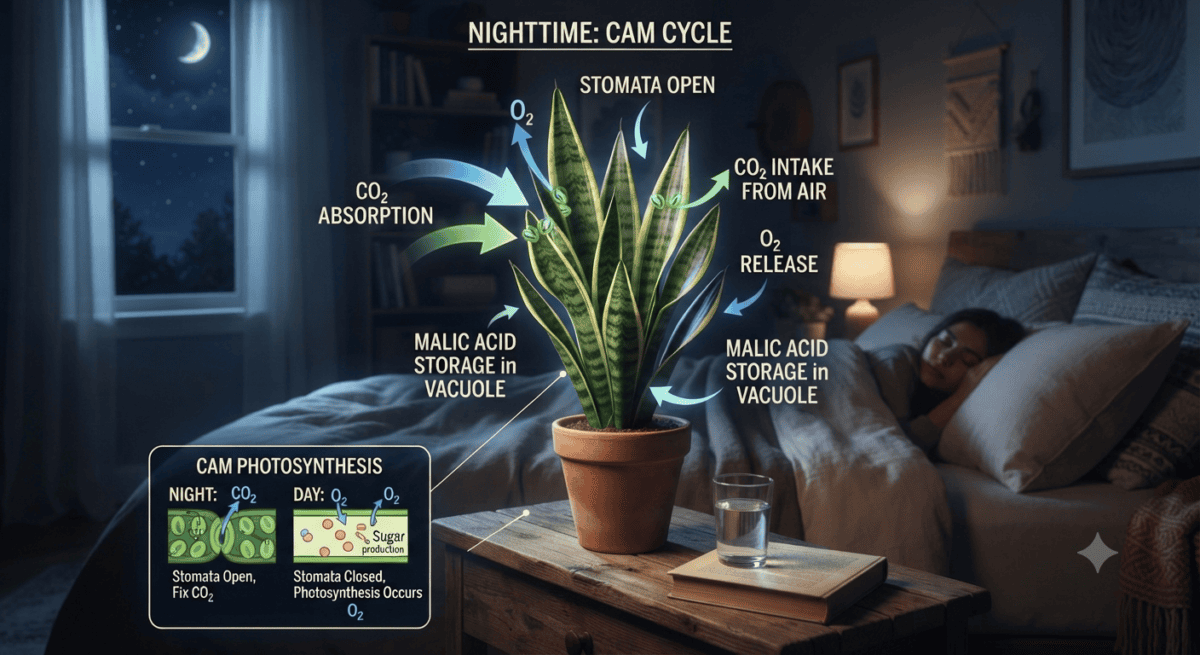
Then there is the snake plant. Tall, striped, sculptural, and nearly indestructible, this classic houseplant does something remarkably different. Native to tropical West Africa and long adapted to dry, sun-baked conditions, the snake plant relies on a specialized photosynthetic pathway called crassulacean acid metabolism, or CAM photosynthesis. Because of this desert survival strategy, it opens tiny pores on its leaves at night instead of during the scorching heat of day. As it pulls in carbon dioxide after dark, it stores it and converts it through its metabolic cycle, continuing to release oxygen overnight when other plants have paused their daytime output.
That quirk is one reason the snake plant became a household favorite and a staple in conversations about indoor air and bedroom greenery. Back in the late nineteen eighties, NASA researchers led by Bill Wolverton published landmark clean air studies examining how common indoor plants interact with sealed environments and volatile organic compounds. While those studies focused heavily on how plants and their root microbes help filter certain pollutants in sealed chambers, the snake plant stood out for its toughness, low maintenance, and nighttime gas exchange. Over time, popular science and home wellness culture blended those findings together, turning the snake plant into an icon of the calm, breathable bedroom.
To understand why a desert plant matters in a modern bedroom, start with how plants normally breathe. Leaves are covered in microscopic pores called stomata. Think of stomata as tiny adjustable gates. When they open, carbon dioxide enters the leaf for photosynthesis, and water vapor escapes into the air. In a lush rainforest or a mild garden, opening those gates during the day makes complete sense. Sunlight is abundant, and water is plentiful enough to replace what evaporates.
In a hot, arid environment, daytime pore-opening is risky. Midday sun heats the air and dries out the leaf fast. If a plant leaves its stomata wide open under a blazing sun, it can lose water faster than its roots can pull moisture from dry soil. CAM plants solved that dilemma by flipping the clock.
Under crassulacean acid metabolism, the plant keeps its stomata closed during the hot, bright hours of the day. That locks moisture inside the thick, fleshy leaves. When temperatures drop and humidity rises at night, the stomata open. Carbon dioxide diffuses into the leaf and is captured into organic acids, primarily malic acid, which gets stored inside large cell compartments called vacuoles. Then, once morning arrives and sunlight returns, the stomata close to conserve water, and the plant breaks down those stored acids to release carbon dioxide internally where sunlight drives sugar production.
Because that gas exchange happens at night, a snake plant behaves differently from a typical leafy fern or pothos plant. While a standard plant is taking in oxygen and releasing carbon dioxide in the dark, a CAM plant like the snake plant is actively taking in carbon dioxide overnight and generating oxygen as part of its cycle.
Still, it helps to keep the numbers and the science grounded in reality. A bedroom is not a sealed space capsule, and a single potted plant is not a mechanical oxygen generator. Humans breathe in thousands of liters of air every day, and a few houseplants produce only a modest fraction of that oxygen compared to the massive volume of air in a room or the outdoor atmosphere. Even so, the biological contrast is real, fascinating, and easy to see once you know how CAM photosynthesis works.
People also love the snake plant for how effortlessly it fits into real life. Many bedroom plants demand fussy watering schedules, humidifiers, or bright windows that some rooms simply do not have. Snake plants, which botanical classification has placed within Dracaena trifasciata and related species, tolerate low light, forgive missed waterings, and thrive in dry indoor air that would crisp up more delicate foliage.
Overwatering is actually the fastest way to hurt one. Because its thick leaves hold water and its roots prefer air and drainage, soggy soil invites root rot. Letting the soil dry out thoroughly between waterings mimics the dry spells the plant evolved to handle in the wild. Give it well-draining potting mix, a pot with drainage holes, and indirect light—or even a dimmer corner—and it will sit quietly upright for years.
Beyond biology and care tips, there is a psychological side to keeping a snake plant near the bed. A healthy green plant adds structure, vertical lines, and a sense of calm to a room meant for rest. Pairing realistic expectations with good plant care lets you enjoy both the quiet beauty of the leaves and the clever desert chemistry happening inside them after dark.


