
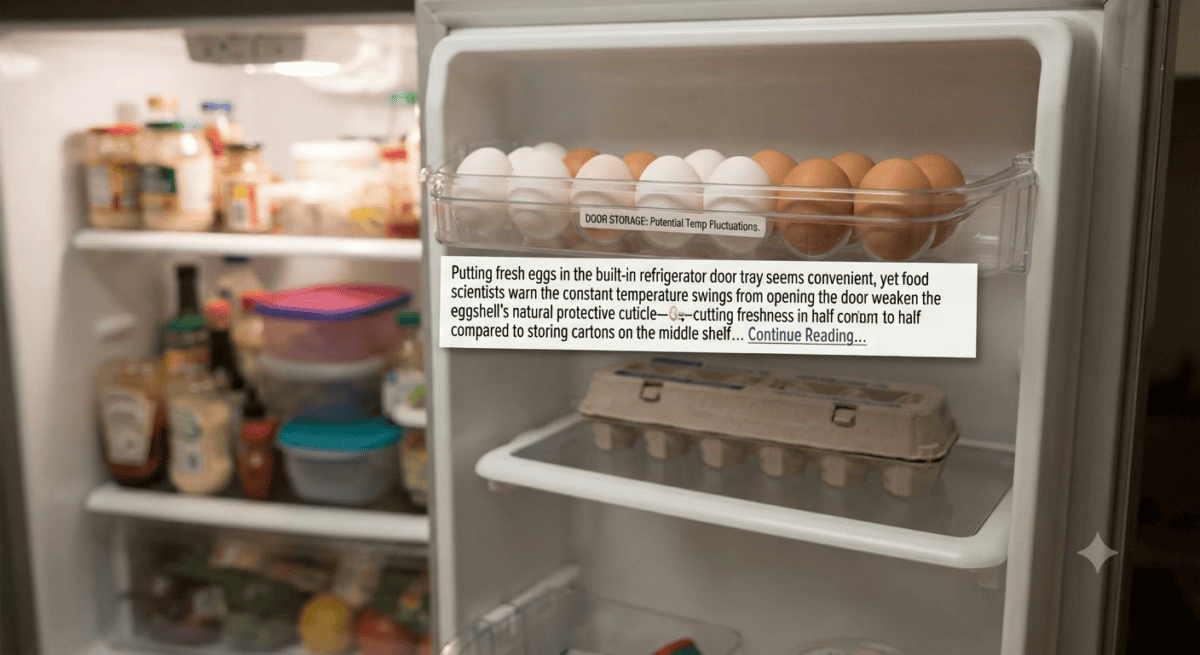
Every time you open your refrigerator door, a rush of warm kitchen air sweeps across the shelves, and the first things to take the hit are the items sitting right in the door compartments. For most of us, that includes a neat row of fresh eggs nestled into that molded plastic tray that came built into the appliance. It feels completely natural to put them there. After all, the manufacturer designed a specific spot just for them, and keeping eggs at eye level makes grabbing breakfast quick and effortless. Yet behind that everyday convenience lies a quiet science experiment that is steadily robbing your eggs of their freshness, flavor, and structural integrity. Food scientists and culinary experts have spent decades studying how temperature, humidity, and airflow interact inside a standard home fridge, and their verdict is surprisingly clear. The refrigerator door is actually the worst place in the entire cold box to store your eggs.
To understand why this happens, we have to look closely at the anatomy of an egg itself. From the outside, an eggshell looks like a solid, impermeable shield, almost like a tiny piece of porcelain. In reality, a standard chicken eggshell is covered in roughly seven thousand to seventeen thousand microscopic pores. These tiny openings exist for a very specific biological purpose. If a fertilized egg were developing into a chick, those pores would allow oxygen to flow in and carbon dioxide and moisture to escape. Because the shell is porous, nature equipped the egg with an invisible first line of defense known as the cuticle, or the bloom. This is a remarkably thin, natural protein coating deposited on the outside of the shell right before the egg is laid. When it dries, it seals those thousands of microscopic pores, acting as a biological barrier that locks moisture inside while keeping bacteria and strong refrigerator odors out.
Here is where the trouble begins in a modern kitchen. In countries like the United States, Canada, Japan, and Australia, commercial eggs undergo a thorough washing and sanitizing process before they ever reach the grocery store shelf. This washing removes dirt, feathers, and potential surface bacteria like Salmonella, which is great for immediate surface hygiene. However, that same washing process strips away the egg's natural cuticle. To compensate for the loss of that protective layer, processors typically spray the eggs with a fine mist of food-grade mineral oil, and then require them to be kept continuously refrigerated from the farm to your kitchen table. Even in regions where eggs are not washed and retain their natural cuticle, that delicate biological barrier is highly sensitive to changes in its environment. Whether your eggs are protected by nature's bloom or a thin coat of mineral oil, their defenses rely entirely on stability.
When you place those eggs in the refrigerator door, you are subjecting them to a rollercoaster of environmental stress every single day. Think about how often the fridge door opens in an average household. Someone reaches in for milk for their morning coffee. A few hours later, someone else opens it to grab lunch ingredients. Kids swing it wide open looking for an afternoon snack, and dinner prep brings another half dozen openings. Each time that door swings outward, the eggs sitting in the door tray are physically carried out of the cold interior and directly into the warm, humid air of your kitchen. Even a brief ten-second opening can cause the air immediately surrounding the door shelves to spike by several degrees. Over the course of a single day, those eggs might experience a dozen or more dramatic temperature fluctuations.
Those repeated swings from cold to warm and back to cold trigger a physical process known as condensation, or sweating. When a cold egg is suddenly exposed to warmer, moister kitchen air, microscopic droplets of water form on the surface of the shell. On a washed egg, this moisture disrupts the thin protective oil coating and creates a liquid bridge across the pores of the shell. Bacteria that might otherwise sit harmlessly on the dry outer surface can now travel effortlessly through those water droplets and straight through the microscopic pores into the nutrient-rich interior of the egg. On an unwashed egg, repeated cycles of condensation and evaporation gradually degrade and wash away the natural cuticle, leaving those seventeen thousand pores wide open to contamination.
Temperature fluctuations do not just weaken the exterior defenses of the egg; they also accelerate the internal aging process at a remarkable pace. Inside a fresh egg, the white, known as the albumen, is thick, cloudy, and firm, holding the yolk plump and centered. This thickness comes from dissolved carbon dioxide naturally present in the egg when it is laid. As an egg ages, carbon dioxide slowly escapes through the pores of the shell. As the gas leaves, the egg white becomes more alkaline, causing the proteins to break down and the white to turn thin and watery. Simultaneously, the membrane surrounding the yolk weakens, causing the yolk to flatten out when you crack it into a pan. Warm temperatures dramatically speed up the rate at which carbon dioxide escapes. Food scientists have found that an egg stored at room temperature ages as much in a single day as an egg stored under steady refrigeration ages in an entire week. While the refrigerator door is certainly colder than your kitchen counter, the constant warming cycles push the eggs through that aging curve roughly twice as fast as eggs kept in a stable cold zone.
There is also the physical aspect of door storage that rarely gets mentioned. Every time you open and close the refrigerator door, the eggs are subjected to gentle, repetitive jostling. If someone closes the door a little too firmly, the eggs rattle against the hard plastic cups of the door tray. Over days and weeks, this constant vibration and micro-impact can cause hairline fractures in the shells that are too small to see with the naked eye, yet large enough to invite bacteria inside. Even without cracks, the physical agitation helps break down the delicate internal structures that keep the yolk suspended in the center of the white.
So if the door is out, where is the sweet spot inside your refrigerator? Food safety experts and appliance engineers universally agree that the middle shelf, positioned toward the back of the main compartment, is the undisputed champion for egg storage. When you place items on the middle shelf near the back wall, they are insulated from the warm air rushes that occur when the door opens. Cold air is denser than warm air, so it naturally sinks and pools in the interior of the fridge, while the back wall sits closest to the cooling vents that circulate chilled air throughout the unit. In this zone, the temperature stays remarkably steady, typically hovering right around thirty-seven to forty degrees Fahrenheit, or about three to four degrees Celsius, regardless of how many times the family opens the door to look for snacks.
Just as important as where you put the eggs is what you keep them in. As tempting as it might be to transfer your eggs into a sleek, clear acrylic organizer or a ceramic egg tray for a tidy aesthetic, leaving them in their original store-bought carton is actually the smartest move you can make. That humble cardboard or foam carton is an engineered piece of protective packaging. First, it acts as a shock absorber, cushioning the fragile shells against bumps and vibrations. Second, it provides an extra layer of thermal insulation, buffering the eggs from minor temperature shifts when the fridge door opens. Third, and perhaps most overlooked, the closed carton blocks out light and absorbs strong odors. Because eggshells are porous, eggs are notorious for soaking up the smells of nearby foods. If you store uncovered eggs next to leftover garlic pasta, sliced onions, or pungent cheeses, you may find yourself eating subtly onion-flavored scrambled eggs the next morning. The original carton acts as a shield against those airborne aromas while also preserving the ideal humidity level around the shells so they do not dry out and lose moisture too quickly. Plus, keeping the original carton means you always have the printed sell-by or Julian pack date right in front of you, taking the guesswork out of knowing how old your eggs really are.
When you place that carton on the middle shelf, pay attention to how the eggs are oriented inside. Most cartons come packed with the pointed end of the egg facing down and the rounder, broader end facing up. There is a very practical reason for this. Inside the broad end of every egg sits a small pocket of air called the air cell. Keeping the broad end up ensures that this air pocket stays safely at the top, away from the yolk. If you store eggs upside down with the pointed end up, the air cell tends to rise toward the yolk, which can cause the yolk to shift out of center and stick to the inside of the shell membrane, accelerating spoilage.
You might wonder why refrigerator manufacturers continue to build egg trays into the doors if food science has proven it is a bad idea. The answer comes down to history and consumer habit rather than modern food safety. Decades ago, when home refrigerators were smaller and less efficient, door compartments were introduced as a clever way to maximize every square inch of space. Consumers loved the convenience, and egg trays became an expected feature on appliance checklists. Today, many modern refrigerators have actually phased out dedicated built-in egg trays, replacing them with general-purpose bins, or including a removable plastic egg caddy that is meant to be placed on an interior shelf rather than hung on the door. Still, the habit persists across generations simply because it is what we saw our parents and grandparents do.
Making the switch from the door to the middle shelf takes less than five seconds, yet the payoff shows up every time you step up to the stove. When you crack open an egg that has been stored in a stable, cold environment, you can immediately see and feel the difference. The yolk stands tall, round, and vibrant, surrounded by a tight, thick halo of firm white that holds its shape in the skillet instead of spreading thinly across the entire pan. If you are poaching eggs, that firm white wraps cleanly around the yolk without turning into wispy, feathery strands in the simmering water. If you are baking, fresh eggs with intact protein structures whip up into higher, more stable meringues and give cakes better lift and texture.
Even if you go through a dozen eggs every few days, proper storage ensures that the last egg in the carton performs just as well as the first. And if you are someone who buys eggs in bulk or cooks with them only occasionally, moving that carton to the middle shelf can easily add two to three extra weeks of peak culinary quality to your supply. Properly stored in their original carton on a cold interior shelf, fresh eggs will easily maintain their quality for three to five weeks past the date they were packed.
It is one of those rare kitchen adjustments that costs nothing, requires zero extra effort, and relies purely on working with the natural biology of your food rather than against it. Next time you unload your groceries, bypass that tempting slot on the refrigerator door, slide the carton onto the middle shelf toward the back, and let steady, quiet cold do what it does best.


